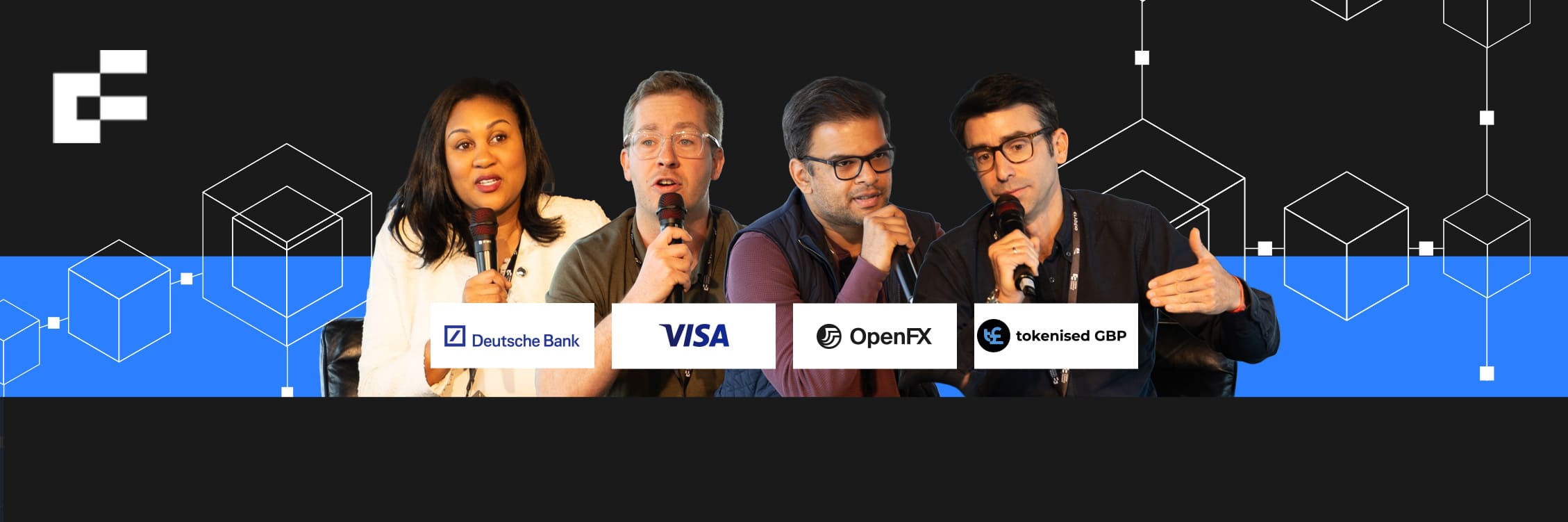
Banking in the age of stablecoins
Key takeaways
- The stablecoin market cap has grown from $5 billion in 2020 to $300 billion today, with 38% of industry insiders predicting the volume to reach $3-10 trillion by 2030.
- Tokenized deposits and stablecoins serve fundamentally different purposes and serious institutions are building for both simultaneously.
- Retail crypto infrastructure breaks completely at institutional transaction sizes, requiring an entirely different technical architecture to operate at scale.
- Bank compliance onboarding remains the single biggest operational blocker in the ecosystem, taking up to two years for major institutions.
- The next frontier is B2B payments and enterprise treasury, a market that dwarfs consumer stablecoin use cases and remains almost entirely unaddressed
Panelists
- Joy Adams – COO, Digital Assets & Currencies | Deutsche Bank
- Alex Dunn – Director, Strategic Growth | Visa
- Karan Shah – Chief of Staff | OpenFX
- Benoit Marzouk – CEO | Tokenised GBP
- Moderator: Antoine Scalia – Founder & CEO | Cryptio
Stablecoins and tokenized deposits are not competing. They are doing different jobs.
One of the most persistent misconceptions in this space is that institutions have to choose between stablecoins and tokenized deposits. Joy Adams pushed back on that framing immediately. Her view is that these two instruments serve fundamentally different purposes. Tokenized deposits carry the full regulatory comfort blanket: KYC, AML, deposit insurance. They are suited for internal settlement and closed-loop workflows between known counterparties. Stablecoins, by contrast, are built for the open loop: wallet-to-wallet, permissionless, broadly interoperable.
"I don't really know of any organisation that's only working on one or only working on the other. They're going to work hand in hand."
– Joy Adams, Deutsche Bank
Deutsche Bank is already operating on both tracks simultaneously, heavily involved in Project Agora while also participating in a consortium developing a bank-issued stablecoin. This is not hedging digital transformation strategy but a recognition that different parts of the financial system will settle on different instruments depending on the use case.
Benoit, who issues a GBP stablecoin, offered a view from the issuer side that reinforced this. His business spans reserve yield, DeFi integrations, on-chain FX, and collateral for margin trading: a stack that only works because stablecoins occupy a distinct space from what banks offer. His framing of the GBP stablecoin as infrastructure for a broader ecosystem, rather than a product competing with deposits, maps directly onto what Joy described.
"I see my company as an infrastructure company, similar to Circle, where you have this orchestration and you connect to other stablecoins or do FX. GBP is 9% of global FX. There are many, many opportunities to generate money."
– Benoit Marzouk, Tokenised GBP
Alex at Visa pointed to the underlying technical tension that makes this distinction meaningful. Stablecoins are bearer instruments. They move like cash, without requiring the counterparty to be identified or pre-approved. Getting a tokenized deposit to behave with that same permissionless quality is one of the harder unsolved problems in the space, and until it is solved, both instruments will have a clear and distinct role – any organisation trying to operate in only one of these two worlds is building half a strategy.
The infrastructure breaks at institutional scale
The most technically revealing part of the panel came from Karan at Open FX, who described what actually happens when you try to move institutional-scale flows through the infrastructure the stablecoin ecosystem has built.
For a $500 USDC-to-MXN transaction, a crypto exchange works fine. The order book has enough depth, slippage is negligible, and the transaction completes. This is why remittances and consumer neobanking have been the natural early use cases: the transaction sizes fit what is available. Scale to $50 million and the dynamic inverts entirely.
"The crypto exchanges are coming and asking us to be customers so they could actually take liquidity. To execute a $50 million USDC to MXN transaction, you cannot send that flow to one single counterparty. You need to slice it, dice it, execute it across multiple different venues."
– Karan Shah, OpenFX
Open FX's answer was to build something that looks almost nothing like a stablecoin company. At its core is an HFT execution layer, routing large transactions simultaneously across major banks, FX brokerages, and hedge funds to minimise slippage. On top of that sits a Web2 FinTech layer covering ERP integrations, TMS connectivity, and payment network APIs. Only then does the Web3 layer sit on top, accepting tokenized assets and routing through on-chain rails where they offer a genuine advantage.
Alex's perspective from Visa validated this architecture from a different angle. Visa's entire model is built on a daily net settlement event, which means upgrading the wholesale and correspondent banking system is critically important. The card network sits on top of it. Stablecoin settlement between issuer and acquirer banks has now hit $7 billion annualised run rate on Visa's network, which did not happen by plugging into retail crypto liquidity. It happened because the right institutional plumbing was in place first.
"Every month the flow comes through. I'm shocked at the growth of this. Various use cases ranging from the wholesale side that underpins the whole system, all the way through to end user capabilities."
– Alex Dunn, Visa
The implication for anyone building in this space is significant. Institutional stablecoin infrastructure is primarily an HFT and FinTech problem, not a crypto engineering problem. The Web3 component is the easiest piece to bolt on. Most companies are building in exactly the opposite order.
The single biggest operational blocker is banks
Ask anyone building in the stablecoin payment space what keeps them up at night, and the honest answer is rarely regulation or technology. From OpenFX's perspective of a digital innovator and payments orchestrator, expansion and integration is the crux of their business model yet, it is the biggest bottleneck of their growth.
"The one single thing within this long list of how to set up a new market that keeps us up at night is banks. There are a lot of evangelists who bring us in, but it's the compliance team who hasn't been told this is a segment we're now working with."
– Karan Shah, OpenFX
Two years to onboard a major bank. One year for a regional bank. The business development teams approves the relationship, but the compliance team operates with a different risk calculus. Approving a novel customer type creates career exposure if something goes wrong; declining it costs nothing. Absent explicit internal guidance, the rational move is always to say no.
Joy offered an honest account of what this looks like from the bank's perspective. Getting large organisations ready for digital assets is not primarily a technology problem. It is a culture problem first, a cost-justification problem second, and a technical build problem third. HR and communications teams are underrated allies in this process, helping the parts of the organisation that are not working on digital assets understand what is coming before it arrives.
Alex at Visa offered the practical lesson from their own experience. The most effective change they made in running stablecoin pilots was bringing compliance in before the commercial conversation even started, treating them as a co-builder rather than a late-stage gatekeeper.
"Bringing the compliance team in very early, almost pre-client, has been incredibly helpful. Things have progressed quite quickly from my point of view, actually."
– Alex Dunn, Visa
That sequencing change has been the single biggest factor in moving faster, and it applies to anyone trying to build institutional relationships in this space.
The UK regulatory window is open, and it matters
Benoit spent 18 months in the FCA regulatory sandbox before receiving a green light to issue and distribute a GBP stablecoin. His read on where the UK currently sits was more constructive than you typically hear from operators in the space.
"For the past month we really saw a shift. I would say the FCA and HMT are pro-stablecoin. We have no issues onboarding even systemic banks, and not every bank has a digital asset strategy, so I'm quite optimistic."
– Benoit Marzouk, Tokenised GBP
The UK operates a dual framework: the FCA regulates non-systemic stablecoins, the Bank of England takes responsibility for systemic ones. Final regulatory text is expected this summer, with a formal application gateway opening in September 2026. For companies operating below the systemic threshold, sandbox approval has been sufficient to build institutional credibility even before full regulation arrives. One sentence from Benoit captured the contrast with the other regulator plainly: "Bank of England is a bit more dogmatic."
Joy's view from Deutsche Bank reinforced why the regulatory direction matters so much for institutional participation. The arrival of frameworks like the GENIUS Act in the US, MiCA in Europe, and the UK's own consultation has shifted the conversation from whether stablecoins are legitimate to how institutions should engage with them. That shift changes the internal politics inside large organisations.
"We've seen the GENIUS Act, we've seen MiCA, the UK is working on its stablecoin legislation. Those regulations are giving more security. Now organisations that want to move ahead in this space need to understand and think about the coexistence of tokenized deposits and stablecoins."
– Joy Adams, Deutsche Bank
For companies building in the UK, the September gateway is not just a compliance milestone. It is the moment institutional engagement moves from exploratory to operational
The B2B gap is the biggest opportunity nobody is filling
Karan's response to an audience question about the ecosystem's challenges surfaced what may be the most important strategic observation of the panel. The current stablecoin ecosystem is almost entirely focused on consumer use cases: remittances, neobanking, card-linked wallets, DeFi borrowing. The enterprise opportunity covering B2B payments, corporate treasury, and supply chain settlement is orders of magnitude larger and almost completely unaddressed.
"If you try to go to Coke and sell them a stablecoin-based payment solution, they're going to laugh you out of the door. The job to be done is to move money. They care about ERP integrations, TMS systems, and true connectivity end to end."
– Karan Shah, OpenFX
Historically, corporate treasury has operated with two separate layers: a software layer managing cash positions and policy, and a money movement layer running on SWIFT and correspondent banking rails. These layers have never been properly integrated. Stablecoins collapse this entirely. Programmable, on-chain money movement means the treasury management system and the money movement layer can be the same system for the first time. Very few people are this yet.
Joy's perspective from Deutsche Bank pointed to exactly why the institutional trust piece matters so much in capturing that B2B opportunity. Enterprise buyers are not going to run large-scale treasury operations on infrastructure they do not trust, regardless of how elegant the technology is. The bank's long-term bet is that the combination of global reach, regulatory compliance, and decades of counterparty trust creates a defensible position as this market develops.
"At the end of the day, having that trusted model is really important when you're doing very large transactions. It's going to be the whole ecosystem working together to build out models that actually work for clients, because that's how you make money."
– Joy Adams, Deutsche BankAlex framed the same opportunity from Visa's position as an orchestrator sitting between the retail and wholesale worlds. The programmable payment use case, the ability to lock a payment conditionally, to release funds on delivery confirmation, to automate treasury movements within defined parameters, is where stablecoins offer something that the existing system genuinely cannot replicate.
"Upgrading all forms of money is where we're focused. The ability to lock a payment, I think that's something that would really benefit the market."
– Alex Dunn, Visa
The companies that build the enterprise infrastructure layer, that speak the language of ERP and TMS as fluently as they speak the language of wallets and smart contracts, will be operating in a market that dwarfs anything the consumer stablecoin space has built so far.
What the room actually believes
At the start of the panel, the audience was asked where the stablecoin market cap would sit by end of 2030, starting from a base of $300 billion today. By the end, 38% had voted for the $3 to 10 trillion bracket: the most bullish option on the table, in a room of institutional investors, bankers, and operators who work in this market every day.
That is not a prediction. But as a temperature check from the people closest to the infrastructure being built, it is worth taking seriously.
About Cryptio
Cryptio is the financial data and ERP platform for regulated digital assets. Trusted by over 450 enterprises including Circle, Gemini, Société Générale and Morpho, Cryptio helps institutions transform on-chain activity into reconciled, auditable, GAAP and IFRS-ready financial records across accounting, reconciliation, reporting, loans, tokenized asset and stablecoin compliance workflows.
Table of contents
- Stablecoins and tokenized deposits are not competing. They are doing different jobs.
- The infrastructure breaks at institutional scale
- The single biggest operational blocker is banks
- The UK regulatory window is open, and it matters
- The B2B gap is the biggest opportunity nobody is filling
- What the room actually believes
- About Cryptio
Explore how
Cryptio can help.
Explore how
Cryptio can help.