.jpg)
Crypto lending is moving decisively into the regulatory mainstream in Europe.
With the introduction of the Markets in Crypto-Assets Regulation (MiCA) in May 2023, and its phased application across 2024, banks and regulated financial institutions can no longer treat crypto lending as an experimental or peripheral activity. Whether offering lending to institutional counterparties, corporates, or retail customers, firms must now meet clear requirements around governance, risk management, reporting, and transparency.
For many lenders, the challenge is not whether to offer crypto lending, but how to do so in a MiCA-compliant, auditable, and scalable way.
This article breaks down:
- What MiCA means for crypto lending activities
- The core compliance and reporting requirements lenders must meet
- How a purpose-built Loan Management System (LMS) becomes essential infrastructure, not just a back-office tool
Why MiCA changes crypto lending fundamentally
MiCA establishes a harmonised regulatory framework for crypto-asset services across the EU. While the regulation does not always refer explicitly to “crypto lending,” lending activities generally fall within MiCA’s scope, where firms provide:
- credit in crypto-assets
- accept crypto collateral
- manage client assets, interest accruals, or liquidations
- offer lending products to retail customers.
For EU banks and credit institutions already authorised under CRD/CRR, a separate CASP licence is not required to conduct these activities. However, crypto lending must still comply with MiCA conduct, custody, safeguarding, and reporting requirements, which apply regardless of the licensing perimeter. In practice, this means crypto lending activities are expected to meet MiCA-aligned, bank-grade standards across:
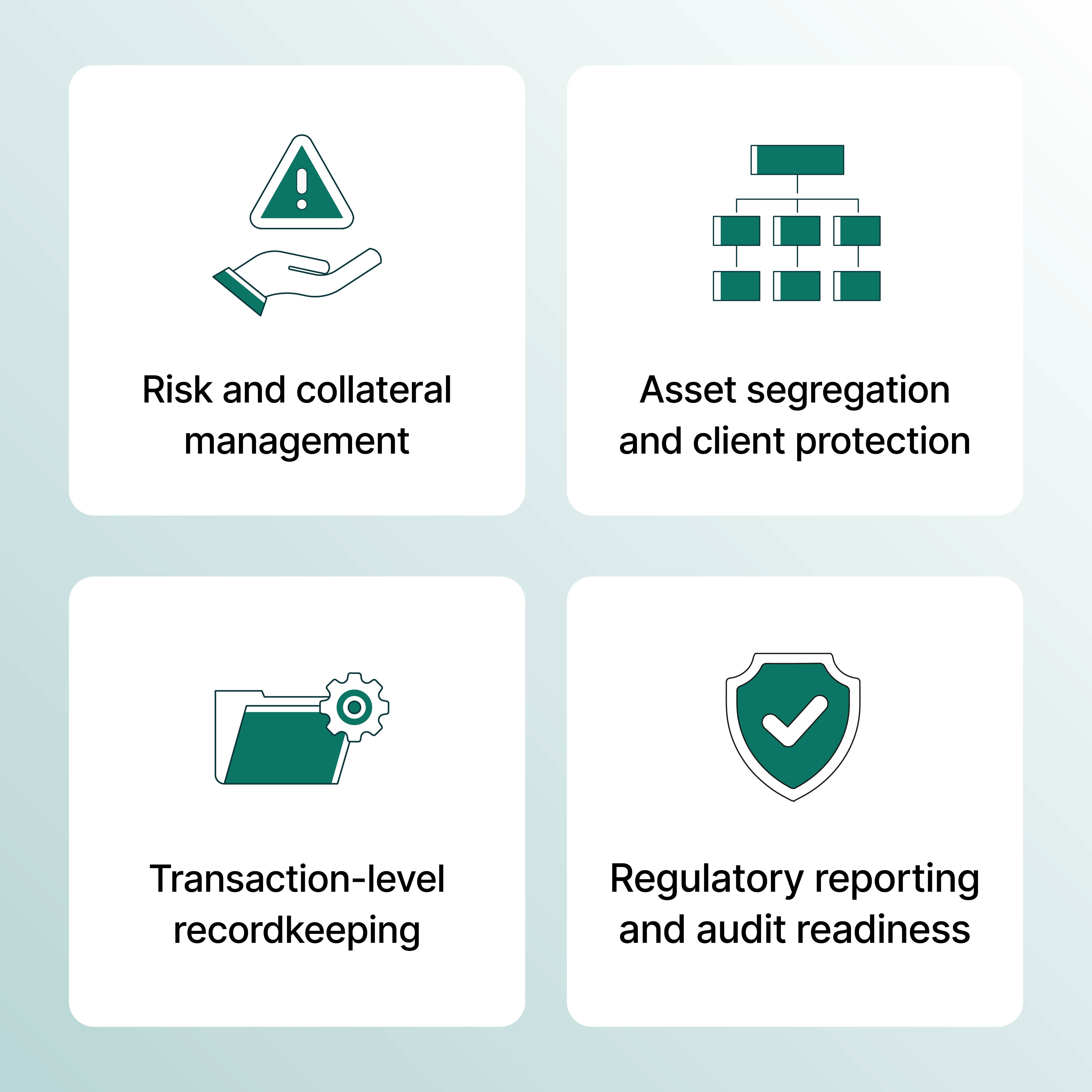
As a result, manual processes, spreadsheets, or loosely integrated crypto tooling are no longer sufficient to support compliant crypto lending at institutional scale.
Key MiCA requirements impacting crypto lending
1. Governance, controls, and auditability
MiCA requires firms to demonstrate strong internal controls and governance frameworks. For lending desks, this translates into the ability to:
- Clearly define loan terms, collateral requirements, and interest mechanisms
- Maintain a complete audit trail of loan lifecycle events
- Evidence controls around margin calls, liquidations, and defaults
Every loan, repayment, interest accrual, and collateral movement must be traceable, reviewable, and defensible.
2. Asset segregation and client protection
For retail and wholesale lenders alike, MiCA places heavy emphasis on protecting client assets.
Lenders must be able to demonstrate:
- Clear separation between client collateral, loaned assets, and house funds
- Accurate tracking of collateral balances over time
- Reconciliation between on-chain activity and internal loan records
This becomes particularly complex when collateral is reused, partially liquidated, or posted across multiple wallets or chains.
3. Risk management and exposure monitoring
MiCA expects firms to actively monitor and manage risk, especially where leverage and collateral volatility are involved.
This includes:
- Monitoring loan-to-value (LTV) ratios in near real time
- Tracking accrued interest and unpaid balances
- Managing margin calls and forced liquidations
- Stress-testing exposure to volatile crypto-assets
Without a structured loan system, these processes quickly become operationally fragile.
4. Reporting and regulatory transparency
MiCA significantly raises the bar for regulatory reporting and supervisory oversight.
Firms must be able to:
- Produce accurate loan and exposure reports on demand
- Reconcile internal loan positions with on-chain transactions
- Support audits with verifiable, time-stamped data
- Respond quickly to regulator or auditor queries
This requires transaction-level precision, not end-of-month estimates.
Crypto lending fails without the right infrastructure
Many early crypto lending operations were built using spreadsheets, including:
- Manual calculations for interest, collateral, and repayments, or
- Trading or custody systems repurposed for credit
Under MiCA, these approaches introduce unacceptable risk:
- Inconsistent data between systems
- Limited audit trails
- Manual errors in interest or collateral calculations
- Delayed or incomplete regulatory reporting
To meet MiCA standards, lenders need a loan-native infrastructure that integrates directly with crypto accounting and reconciliation. In a supervisory review, the absence of automated controls, real-time monitoring, and reconciled data is not treated as a tooling gap - it is treated as a risk management failure.
Purpose-built Loan Management System for EU banks and regulated lenders
Cryptio’s Loan Management System (LMS) is designed for European banks and regulated lenders operating crypto lending under MiCA-grade controls. It provides a single, auditable system of record for the full loan lifecycle, bringing together loan origination, interest accrual, repayments, margin events, and collateral movements into a single, consistent view. All loan data is reconciled against on-chain activity, allowing firms to evidence accurate positions, segregation, and exposure at any point in time.
Beyond day-to-day operations, Cryptio LMS is built to support supervisory scrutiny and audit requirements. By integrating directly with Cryptio’s accounting and reconciliation engine, it delivers transaction-level audit trails, regulator-ready reporting, and defensible data during reviews or investigations.
Cryptio is already trusted by 450+ crypto enterprises and institutions, including SG Forge (Societe General Group), Morpho Labs, Inxy, and Bitstack, for its accounting and tokenization compliance solutions. LMS is built on the same proven infrastructure, aligned with SOC 1 and SOC 2 standards, and designed to integrate seamlessly with existing finance, risk, and compliance workflows.
MiCA compliance is not just legal, it’s operational
MiCA does not just require the right licenses. It requires the right systems.
For crypto lending, compliance lives in the details:
- How loans are tracked
- How collateral is reconciled
- How interest is calculated
- How exposures are reported
Cryptio’s Loan Management System turns MiCA from a compliance burden into a scalable operating model, enabling lenders to grow crypto credit offerings with confidence.
Final thought: Build once, scale across Europe
MiCA creates a single regulatory standard across the EU. For banks and lenders, this is an opportunity, not a constraint.
By investing in MiCA-ready loan infrastructure today, institutions can:
- Launch compliant crypto lending products faster
- Reduce operational and regulatory risk
- Scale across European markets without re-architecting systems
Cryptio LMS provides the foundation to do exactly that. Book a free consultation session to learn more.