Tokenized securities and vaults in the new era of the SEC
Key takeaways
- There are multiple models for tokenized securities. Issuer-sponsored, custodial and wrapped structures create different relationships between the token, the underlying asset and the investor – and all three may have a role in the market.
- Programmability expands what investors and institutions can do with assets. Tokenization can streamline collateral, automate portfolio management, broaden access to private markets and enable new relationships between issuers and shareholders.
- Traditional and digital market infrastructure will operate side by side for years. Existing books of record, custody, tax, reporting, corporate actions and governance cannot simply be switched off as assets move on-chain.
- Regulatory permission is only one part of adoption. Distribution, adviser education, custody infrastructure, investor protections and reliable downstream operations will determine whether tokenized products scale.
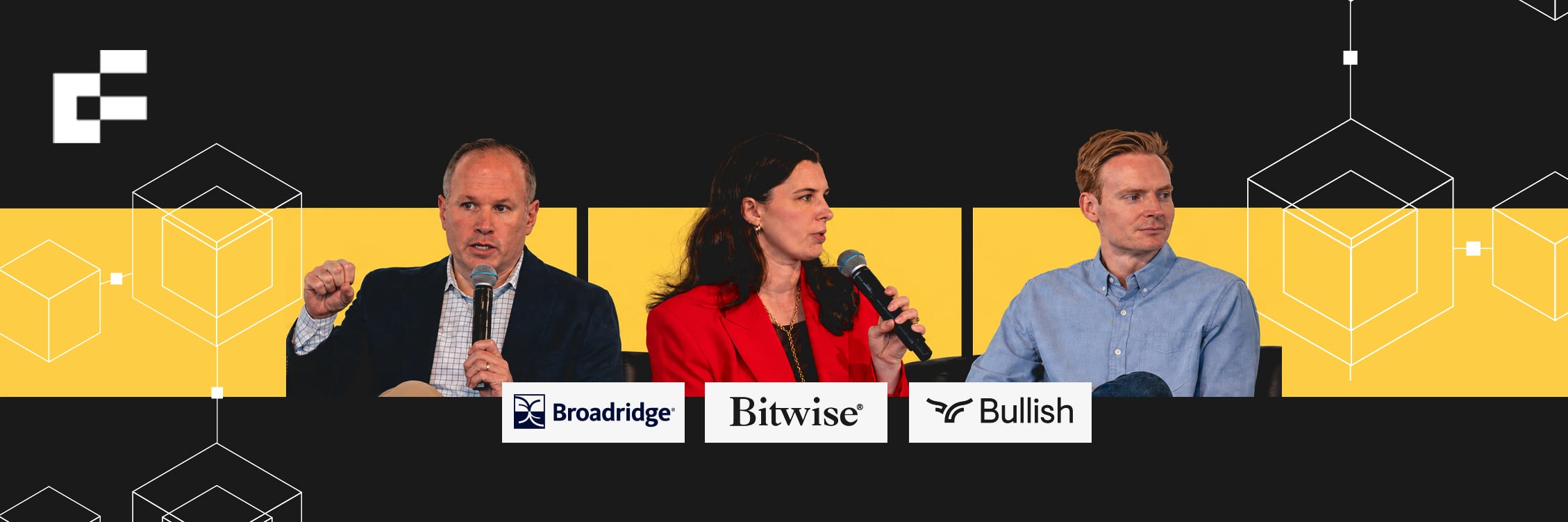
Panelists
- Thomas Cowan – Head of Tokenization | Bullish
- Johanna Collins-Wood – General Counsel & Head of Compliance | Bitwise Asset Management
- Robert Krugman – Chief Digital Officer | Broadridge
- Moderator: Hemant Pandit – CRO | Cryptio
The first question is what the token represents
“Tokenized stocks” can sound like a single product category. In practice, the market is developing several distinct structures.
Thomas Cowan outlined three broad models.
The first is issuer-sponsored tokenization, where the token itself represents the share. The second works through the existing securities infrastructure, with the underlying asset remaining within the traditional custody structure while an entitlement is represented on-chain. The third is the wrapped or synthetic model, which has seen significant adoption outside the U.S. and gives investors tokenized exposure to an underlying security rather than making the token the security itself.
Thomas's view was that these models do not necessarily have to converge on one winner. Different structures can serve different markets and use cases.
The discussion also highlighted why an old piece of capital-markets infrastructure – the transfer agent – has suddenly become central to tokenization.
A transfer agent maintains an issuer's shareholder register: the record of who owns what. As Thomas put it, blockchain is well suited to that function because it is effectively a distributed ledger. Technology that has historically operated on decades-old infrastructure can therefore be modernized without changing the basic purpose of the system.
In that sense, tokenization can look less like inventing an entirely new asset class and more like the transition from on-premise technology to cloud infrastructure: a change in the underlying plumbing that can unlock new functionality above it.
Traditional and digital market infrastructure will run in parallel
Moving the ownership record on-chain does not make the rest of the capital-markets stack disappear.
Rob Krugman pointed to the hundreds of millions of brokerage accounts already supported by existing infrastructure. Behind those accounts sit statements, confirmations, tax processes, regulatory reporting, lending, risk, proxy voting, corporate actions and other downstream services.
Those systems cannot simply be ripped out.
“You can't just turn a switch and go from traditional assets to digital assets… these two systems are going to work in parallel for the foreseeable future.”
– Robert Krugman, Broadridge
Broadridge's approach today includes taking on-chain data and feeding it into existing infrastructure so the downstream processes institutions already rely on can continue operating while digital-asset capabilities are added.
Governance illustrates the challenge.
Broadridge has worked on proxy voting across native tokenized securities, custodial structures and wrapped assets. But the wrapped model can create new questions. If somebody acquires a token through a DeFi protocol and the issuer does not directly know who they are, what shareholder rights should follow? How should voting or other corporate actions reach that holder?
The technology can make parts of the process more efficient, but the functions the existing system performs still have to happen.
For finance and operations teams, that means the transition is likely to involve a prolonged period where on-chain and traditional representations of financial activity have to be consolidated and reconciled.
The asset itself becomes more useful
One of the clearest themes from the panel was that the value of tokenization extends beyond trading the same asset on a different rail.
Rob called collateral the “ultimate superpower” of tokenized assets.
Institutions have used securities as collateral for decades, but tokenized assets can make collateral movement faster and reduce the time required to execute those processes. That opens the possibility of putting assets to work more efficiently rather than leaving them trapped inside fragmented systems.
The same logic can extend to investment access.
Rob highlighted private equity, private credit, venture capital, real estate and other alternative investments that have historically required substantial minimum investments and long holding periods. Tokenization alone does not remove investor eligibility requirements, but it can change the mechanics around how those assets are represented, distributed and combined into portfolios.
Instead of requiring an investor to make a large direct commitment to an individual private-market fund, tokenized assets could potentially support smaller allocations that are then incorporated into professionally managed strategies.
Thomas described these assets as new “Lego blocks” for asset managers: components that can be combined into products and portfolios in ways that become easier once ownership and transfer operate on programmable infrastructure.
The important shift is not simply that more assets can be traded. It is that those assets can become easier to move, combine, automate and use elsewhere in the financial system.
The adviser stays. The portfolio changes.
Tokenization is often discussed through the lens of 24/7 self-directed markets. Johanna Collins-Wood offered an important counterpoint.
A significant proportion of U.S. wealth is managed through registered investment advisers (RIAs). People with meaningful assets often do not want to manage those portfolios themselves, regardless of whether markets technically trade around the clock.
Advisers also operate within suitability requirements, platform restrictions and other obligations governing which products they can recommend to clients.
Tokenization does not remove those responsibilities. It can, however, change the tools available to advisers.
Johanna used Bitwise's ATPs as an example. Model portfolios themselves are not new: asset managers have created suggested allocations for years.
The difference is how those strategies can be executed.
With tokenized assets, a set of securities could be automatically purchased and subsequently rebalanced inside a wallet according to the chosen strategy.
“It's not that the concept is new, but it's that the technology is enabling an easier way to do something and removing a lot of friction.”
– Johanna Collins-Wood, Bitwise
That distinction may ultimately matter more to investors than whether the underlying infrastructure is described as blockchain.
If portfolio construction, rebalancing, collateral and movement between products become easier, tokenization can change the user experience without requiring people to become experts in the technology underneath it.
The panel even touched on pensions and retirement products. Johanna was careful to note that current ATP structures are for non-U.S. investors and that pension products face substantial regulatory requirements. But she saw broader potential in using programmable infrastructure to automate investment processes that remain cumbersome today.
Programmable ownership creates new relationships
Tokenization can also change the relationship between issuers and their shareholders.
Thomas pointed to one consequence of an issuer-sponsored model: when the share itself is represented on-chain, an issuer can potentially gain much greater visibility into who actually owns its stock.
That creates possibilities beyond settlement.
His examples included giving shareholder benefits directly to token holders, offering discounts to investors, or using wallet-based incentives to encourage participation in proxy voting.
The significance is that two relationships that have historically existed separately – customer and shareholder – can start to overlap.
For issuers, that could make tokenization relevant to investor relations and distribution as much as market infrastructure.
For asset managers, programmable assets create new ways to assemble investment products.
And for investors, the value may ultimately show up through better access and simpler products rather than through direct interaction with blockchain technology.
Eventually, the token should disappear from the experience
Both Rob and Thomas returned to a similar end-state: tokenization reaches maturity when users stop thinking about tokenization.
Rob described a future where investors simply log into a broker and find that the universe of available assets has expanded significantly. The broker might be a traditional institution, a crypto platform or something entirely new.
The user should not need to understand wallet addresses, blockchain architecture or the terminology that has grown up around digital assets.
Thomas compared the eventual role of tokenization to encryption.
“We don't even think about encryption these days at all, but it is the back end for literally every single thing that you do on the internet today. That's what it will be 10 years from now.”
– Thomas Cowan, Bullish
In his ideal outcome, even the title “Head of Tokenization” eventually becomes unnecessary because the technology has simply become part of the financial infrastructure underneath new products and services.
That gives tokenization a different measure of success.
The question stops being whether an investor knows they own a tokenized security, but rather if the new rails give them better access, more efficient collateral, easier portfolio management or products that would have been difficult to deliver using the old infrastructure.
Tokenizing ownership doesn't remove the need for a trusted record
For all the potential benefits, trusted ownership and books of record remain fundamental.
Rob illustrated that with a story from Hurricane Sandy.
The basement of 55 Water Street in Manhattan, where physical stock certificates had historically been stored, flooded. Teams ended up using industrial dryers while trying to establish who owned what.
It is an amusing example of a very serious problem: the traditional system should not automatically be treated as optimal simply because it is established.
But Rob also cautioned against the opposite assumption.
Could institutions replace the existing market infrastructure with blockchain today? Technically, perhaps. Would doing so immediately make everything simpler? His answer was no.
Large institutions have enormous downstream ecosystems built around their existing records. Replacing those systems before sufficient adoption exists would add cost and complexity rather than remove it.
Custody is one of the first practical questions institutions encounter.
Where will tokenized assets sit? Will the institution use a third-party digital custodian or develop the capability itself? How will those holdings connect to its existing book of record and downstream processes?
Rob expects the growing involvement of established banks and custodians to provide additional confidence to institutional participants, even if some firms ultimately choose to build more of the infrastructure themselves.
Tokenization changes the technology supporting ownership. It does not remove the need to prove ownership, control the asset and reconcile the record.
A tokenized product still has to reach the investor
The Bitwise experience with crypto ETFs provided another useful lesson: technical and regulatory availability do not create adoption on their own.
Registered investment advisers run their businesses through specific platforms. Before advisers can meaningfully consider a product for clients, that product generally has to be available through the infrastructure they use.
Johanna said the approval of spot crypto ETF products across major wealth-management platforms created a significant unlock. But platform approval was only the beginning.
Advisers then had to learn:
what the product is, where it belongs in a portfolio, which clients it may be suitable for and how it fits within their existing obligations.
That education takes time. Johanna noted that there is often a lag between a product arriving on a platform and meaningful investment flows following it. At the time of the panel, she saw the market as still early in that process.
The same lesson applies to tokenized securities.
Creating a technically superior instrument is only part of the job. It still needs custody, distribution, adviser understanding and a compelling reason for issuers and investors to change what they already do.
The SEC has opened the door, not flipped the switch
The panel took place shortly after a significant change in the U.S. regulatory environment for tokenized equities.
Thomas cautioned against interpreting the SEC's innovation exemption as a moment where the entire U.S. equity market suddenly moves on-chain.
His description was much narrower: an initial framework allowing specific token structures and market models to demonstrate what works.
“This is happening, this is real… [but it is] the first of a much longer shift to get equities on chain.”
– Thomas Cowan, Bullish
The importance lies in creating room to experiment while maintaining the protections owed to issuers and investors.
Rob reinforced the point from a market-infrastructure perspective. Turning a security into a token does not eliminate the rights and obligations attached to it. Investors still need to receive dividends, vote, participate in corporate actions and retain the protections associated with the underlying security.
At the same time, he sees institutional infrastructure accelerating. He described the coming period as a potential “year of the unlock” as banks and broker-dealers build wallet and custody capabilities and established market operators move further into tokenization.
Thomas offered the longer-term view: firms best positioned for the transition may be those capable of operating in both systems.
Traditional infrastructure is not disappearing overnight. Digital infrastructure is no longer hypothetical either.
For the next several years, the opportunity sits in connecting the two.
About Cryptio
Cryptio is an institutional-grade data engine for accounting, reconciliation, fund administration and credit in the digital assets and AI era.
As securities, funds and other financial assets move on-chain, institutions have to maintain reliable financial records across both tokenized and traditional infrastructure. That means connecting blockchain activity with custodians, transfer agents, exchanges, internal books and existing financial systems without losing visibility into the underlying economic activity.
Cryptio provides the data and reporting infrastructure institutions need to bring those environments together. Its platform transforms complex on-chain and off-chain activity into normalized, reconciled and auditable financial records, supporting accounting, reporting and operational control across digital assets.
For institutions issuing, administering or operating around tokenized assets, Cryptio helps establish a consistent financial data layer across the lifecycle – connecting activity on digital rails with the books, controls and reporting infrastructure regulated finance still depends on.
Table of contents
- The first question is what the token represents
- Traditional and digital market infrastructure will run in parallel
- The asset itself becomes more useful
- The adviser stays. The portfolio changes.
- Programmable ownership creates new relationships
- Eventually, the token should disappear from the experience
- Tokenizing ownership doesn't remove the need for a trusted record
- A tokenized product still has to reach the investor
- The SEC has opened the door, not flipped the switch
- About Cryptio
Explore how
Cryptio can help.
Cryptio can help.